


CSDR’s Formidable Swimmer
Jul 26
4 min read
Unlike most babies at birth, Barbara Carr entered the new world with two permanent conditions: deafness and cerebral palsy. She learned how to co-exist with them in her daily routine. By virtue of hard work and positive attitude, the two conditions became less and less a challenge for her over the decades.
In 1956, Barbara started her K-12 education at the relatively new school for the deaf in Riverside. Her family resided in Pomona which made it necessary for her to live in the age appropriate dorm for the next 13 years. As a devoted mother, she drove to CSDR every Friday to pick up Barbara for the weekend with the family and returned her to the dorm on Sunday evening for a new week of school.

Like all other students, Barbara led a busy student life from dawn to dusk in the highly regimented structure both in school and dorm. With the emphasis speech therapy for all grades, Barbara was able to make nice progress in her pronunciation despite her shaky
motor coordination. Along with speech, she also picked ASL.
In the 1950s and the 1960s, CSDR was one of few schools with a swimming pool in Riverside. Barbara learned early in life that swimming was an excellent sport to help her become stronger and better coordinated for body movement.
Barbara’s discovery of benefits in swimming reminds me of the famed deaf lifeguard named Leroy Colombo (1905-1974) in Texas. Leroy was stricken with spinal meningitis (brain fever - a common cause of deafness) at age of seven. The fever also left him with useless legs. His two older brothers helped him walk with support and swim everyday. One year later, Leroy was able to walk again. The water therapy got him hooked to swimming for life. He won marathon swims for competition. He worked as a lifeguard for the city of Galveston for 40 years. He set a world record of 907 rescues. The swimming pool at the Texas School for the Deaf is named after him as Colombo Swim Center.

In the 1960s, CSDR didn’t have swimming for league competition. Barbara signed up for competition in El Monte for weekends and summers.

Introduced to the water therapy at a young age for her condition, Barbara quickly developed into a formidable swimmer. Her talent was recognized by Coach Don La Mont of the El Monte Recreation Club. Following her selection for the U.S. squad for the 1968 Nationals, Barbara represented the United States in the 1969 Deaf Olympics.

During this time, she began training in Los Alamitos under Greta Andersen, Denmark's former Olympic gold medalist. Andersen noted that despite her physical limitations, Barbara was strong, fast and constantly learning, which laid the foundation for a close relationship between the two. Under Andersen's guidance, an 18-year-old Barbara prepared for and competed in the Deaf Olympics in Yugoslavia in eastern Europe.
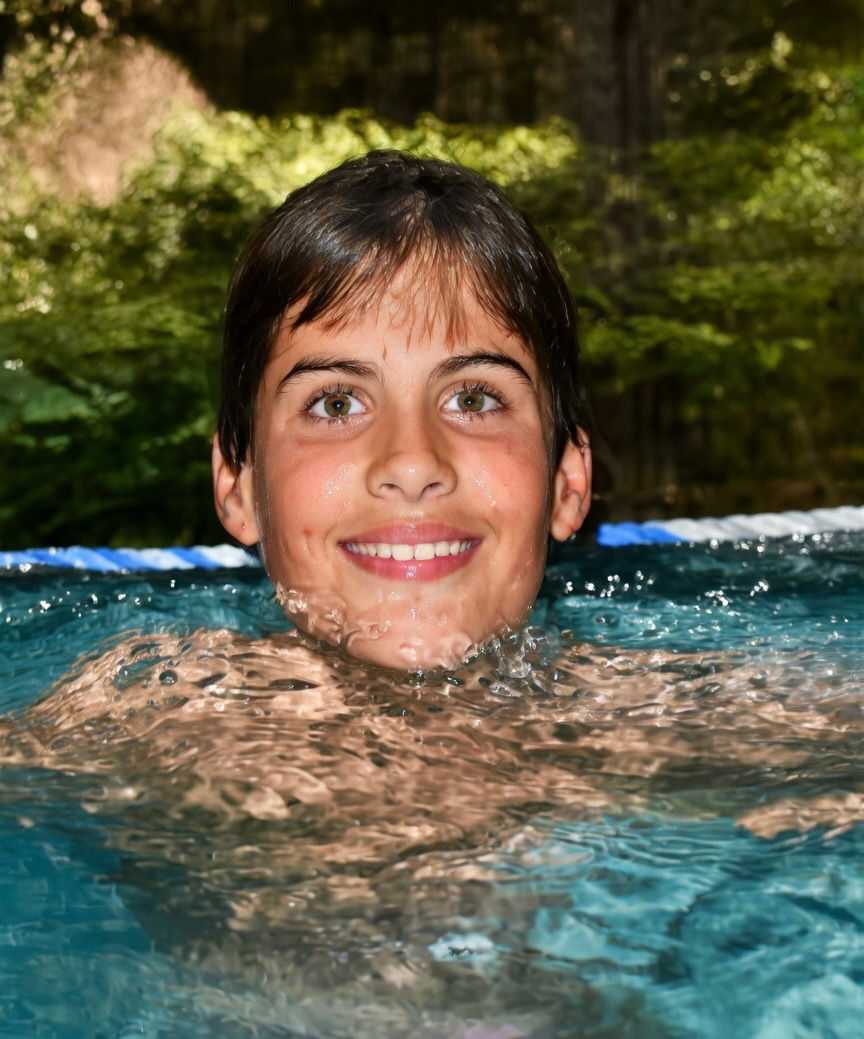
In September 1972, Andersen invited Barbara to join her on a swim from Avalon Bay on Catalina Island to the famed Queen Mary ocean liner in Long Beach Harbor. Barbara accepted immediately, eager to tackle the challenging channel swim alongside her mentor.

Reflecting on the experience, Barbara recalled the cold water and her decision to use Vaseline rather than a wetsuit for warmth. A support boat navigated alongside her, using a light to communicate and providing hot gelatin tea with honey and broth every thirty minutes for hydration. Barbara noted that transitioning from a pool to the ocean presented significant physical and mental challenges.
After ten hours of constant swimming, Barbara successfully completed the swim. She expressed immense pride in this achievement, noting that the support of her parents was instrumental in making these pursuits possible. Guided by a determination to prove that her physical limitations would not restrict her, she aimed to serve as an example for others to pursue their dream.

Later in life, at the age of fifty, Barbara challenged herself further by participating in a triathlon at Treasure Island in San Francisco. Following a rigorous and novel training regimen, she finished in the middle of her age pack with a time of two hours.

Today, Barbara is a mother of three and a grandmother. She views her achievements as personal challenges she set and met for her own fulfillment.

Despite her rough start in life, Barbara managed to live her life productively most of her life. Swimming is probably the best example of her steel determination to overcome the physical limits (cerebral palsy).
Barbara Carr may be a good candidate to be named for the CSDR swimming pool in the future.
Kevin Struxness, ’76, MA
Editor, CSDR Old Times
27 July 2026



Comments